
Words
Explore meanings, articles, parts of speech, and examples.
01 · ANALYSIS CARDS
Go beyond looking up a word. Explore grammar, examples, corrections, and natural phrasing, all together on an analysis card.
Start analyzing →
Explore meanings, articles, parts of speech, and examples.
Check grammar and natural phrasing.
Find natural ways to express them in German.
02 · INSIDE THE CARD
The sections depend on your input and the part of speech. Expand a collapsible heading and start with what you want to know.
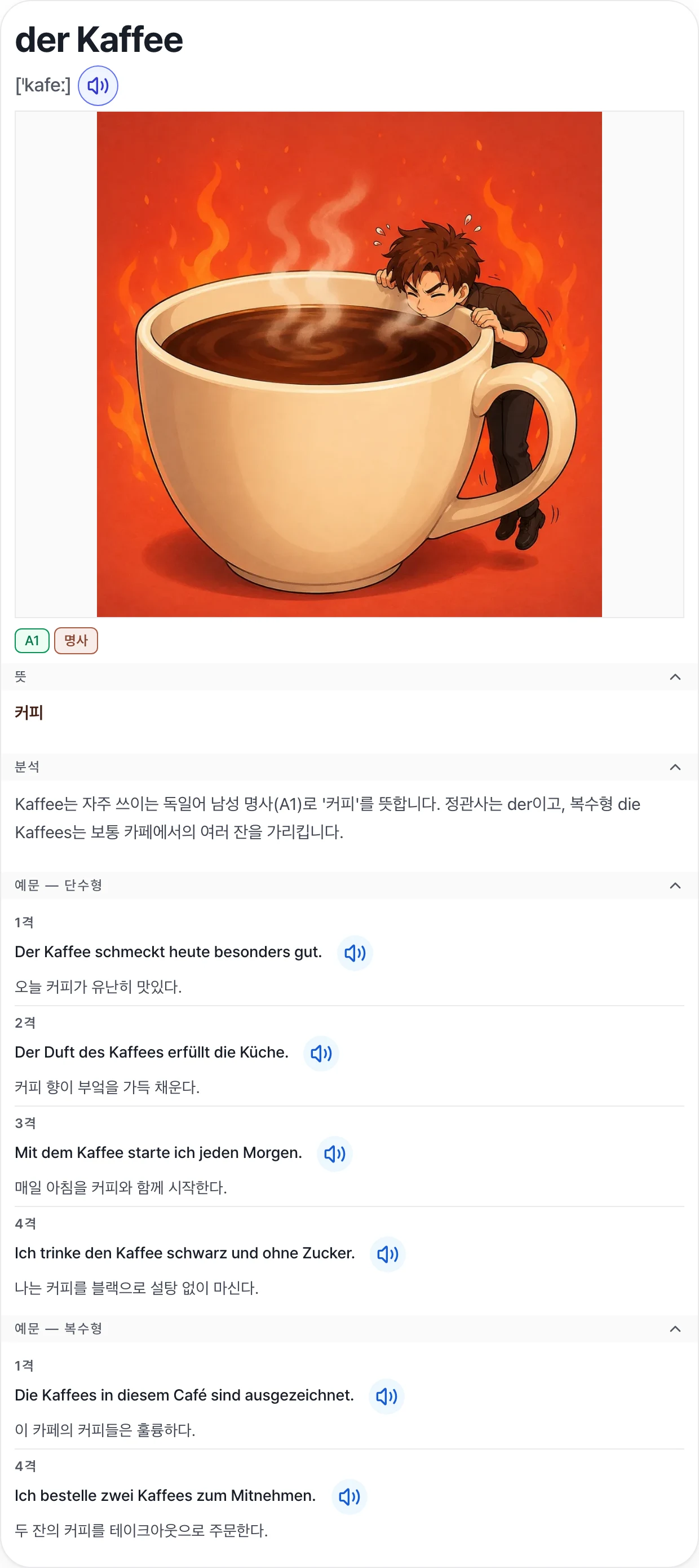
SECTION 1
Read the word with its article, as in der Kaffee. Check the pronunciation guide and press play to hear it.
SECTION 2
Identify nouns, verbs, and other parts of speech. CEFR is a guide to difficulty, not a test score.
SECTION 3
If a word has several meanings, read them separately. Find the one that fits your context.
SECTION 4
Read explanations of usage and grammar, including details that a literal translation may not make clear.
SECTION 5
Check gender, number, case, and inflection. Extra sections, such as verb conjugations, depend on the part of speech and level.
SECTION 6
Read and hear sentences in use. Expand more examples or connect a sentence with an image.
The sections shown on a card depend on your input and the part of speech.
03 · GERMAN SENTENCE CORRECTION
Enter a German sentence to see its translation and sentence status. Where available, read suggested corrections or more natural phrasing and find out why it changed.
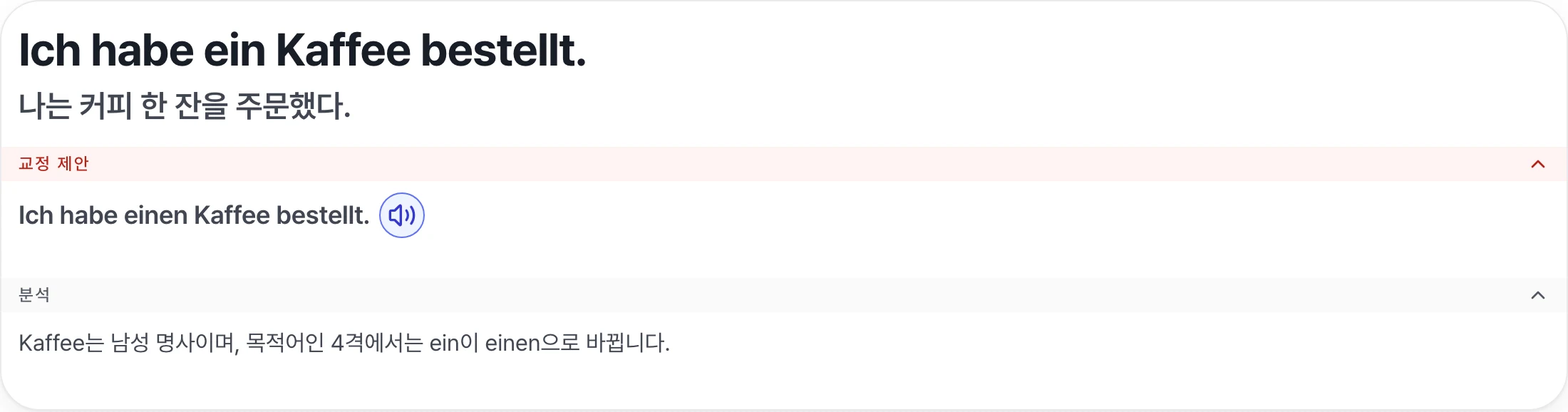
Kaffee is masculine and is the object here. In the accusative case, ein becomes einen.
Original and translation → sentence status → correction or natural phrasing → analysis → difficult terms, when available. Use the play button beside a correction to hear the correct expression.
04 · START IN YOUR OWN LANGUAGE
Select German as your learning language and Korean as your language. Enter a Korean sentence to read a suggested German expression, its meaning, and its usage in Korean.

This expression politely asks for a cup of coffee. Use hätte gern to say what you would like politely.
Listen to the suggested expression and repeat it. Save sentences you want to use again as your own cards.
05 · PARTS OF SPEECH AND GRAMMAR
You don’t need the same table for every word. The details and examples vary by part of speech, so focus on what fits the word you’re learning.
Check the article, meaning, plural, and other available grammar details together. Read the article and noun as one unit.
Check forms for each person, such as ich gehe and du gehst. Read the available tense and usage examples to see the differences.
Look for relevant details, such as adjective comparatives and the cases used with prepositions. Read examples separately for each meaning.
06 · EXAMPLES AND AI IMAGES
Generate AI images from an analysis card to give words and examples a visual cue. Read the example and connect it with the scene.
Open “Generate AI image” on the card and check the expression you want to illustrate.
Choose standard or high quality and check your current and required AI credits. High quality takes longer and uses more credits.
Select “Create” and check the generation status. Once it finishes, use the image on the card to connect the meaning with a scene.
Connect it with red and fire. Say der Kaffee aloud and picture the scene.
Blue and ice for die; yellow and lightning for das. The image gives you a cue for the word’s meaning and grammatical gender.
Expand “Show more examples.” Playback and image tools beside a sentence are available for the corresponding content.
07 · NATIVE VOICE GENERATION AND SAVING
Generate audio in a voice of your choice from an analysis card and listen to the expression’s sounds and rhythm. Select available audio to listen, and collect cards in a deck to keep learning.
Open “Native voice” on the analysis card and check the text to generate.
Select a voice and check which audio is already available and which needs to be generated.
Check the required AI credits before generating. Select the finished audio, listen to its intonation and rhythm, and repeat it.
Press play beside a word, example, or correction to hear it. If there is a correction, practise the corrected sentence.
Collect cards you want to learn again in a deck. A deck is a collection of your learning cards.
After listening and speaking, hide the answer and try recalling it. Check whether you remember what you understood.
08 · GET STARTED
AI explanations can be wrong. Read the meanings and examples, and check anything that seems unusual. Start with one expression you’re curious about.
Start analyzing →Try a single word, then a short German sentence, then something you want to say in your own language.
Take an expression you understood with an analysis card and say it aloud in shadowing.